Independent Global Intelligence • London • Frankfurt • New York
Advertisement
Front Page/Crypto/America at a crossroads: Commissioner Peirce’s parting challenge
Cryptovia CoinDesk
2 October 2026 at 13:22•5 min read
America at a crossroads: Commissioner Peirce’s parting challenge
America at a crossroads: Commissioner Peirce’s parting.
High-resolution curated imagery via CoinDesk wire syndication.
Executive Takeaways • Key Intelligence
▪Strategic intelligence desk confirms key developments surrounding It is incumbent upon us to continue Commissioner Peirce’s mi.
▪International stakeholders analyze: Today is Hester Peirce’s last day as an SEC Commissioner.
▪Multilateral policy, financial liquidity, and regulatory frameworks face direct realignments.
Advertisement
In an authoritative intelligence dispatch verified through CoinDesk, significant international developments have emerged regarding America at a crossroads: Commissioner Peirce’s parting challenge. Observers across key diplomatic, corporate, and policy corridors are actively parsing the immediate impact, as corroborated by verified wire filings.
It is incumbent upon us to continue Commissioner Peirce’s mission, writes Will Schwartz, policy associate at the Blockchain Association. Today is Hester Peirce’s last day as an SEC Commissioner. The digital asset industry, and every American who believes regulation should mitigate risk and foster innovation, owes her an enormous debt of gratitude.
For more than eight years, Commissioner Peirce served as a principled voice at the Commission. Under the previous SEC Chairman, she frequently dissented when the Commission chose to bring enforcement actions rather than write rules the industry could comply with. She proposed a token safe harbor years before regulators were ready to listen.
Advertisement
Advertisement
She led the Crypto Task Force and insisted that the agency’s duty to protect investors meant it must use its authority to provide regulatory guardrails for the rapidly expanding industry. Commissioner Peirce brought humility, conviction, and a sense of humor to work every day. Washington could use more like her.
Although she will no longer be at the SEC, her presence and the ideals she stood for will live on. Will Schwartz is a Policy Associate at Blockchain Association, where he conducts research and analysis on digital asset legislation, regulation, and emerging policy developments.
In some of her last public remarks as Commissioner, at SIFMA’s Digital Assets Conference on September 23, Peirce did not take a victory lap. Rather, she outlined the work that is still to be done—even in her absence. As she described in her speech, our society is at a great crossroads.
Advertisement
Advertisement
Down one road is the world we’ve been living in: dragnet surveillance, the datafication of every aspect of life, and cybersecurity breaches that expose our most sensitive information to bad actors all around the world.
Down the other is a world of both privacy and security, where Americans can prove that they’re following the law without handing over their sensitive personal information. Commissioner Peirce has firsthand experience seeing how our financial regulations are designed to extract as much personal data from American consumers as possible.
For more than 50 years, our regulatory framework has been built upon the mass collection and storage of personal data from all Americans who interact with the financial system.
Advertisement
Advertisement
Businesses collect personal data from consumers and share it with the government, which aims to track down actual criminal activity — the “needle,” as Commissioner Peirce puts it, in the “haystack” of innocent, unassuming Americans’ data. The needle is rarely found in the haystack.
Yet the law is designed as if the bigger the haystack is, the easier it is to find the needle, when the opposite is true. The status quo leaves the government with an enormous cache of consumer data it must sift through, looking for evidence of criminal activity. And the consequences of this mass collection and storage of data are stark.
Centralized stores of data make breaches far more damaging, exposing consumers to greater harm and jeopardizing our collective national security. Mandated disclosures also feed data brokers, who scrape public filings and records to build and sell detailed profiles that companies use to target, price, and profit from consumers.
Advertisement
Advertisement
And mass surveillance leaves Americans — regardless of their political beliefs — vulnerable to censorship and discrimination. The dire state of digital privacy will only worsen as AI becomes more integrated into everyday life, collecting more data and enabling more sophisticated surveillance and profiling of individuals.
But America does not have to go down the road of endless surveillance. There is another path at Commissioner Peirce’s crossroads that we can take, one where consumer privacy is not sacrificed in the name of security. The two are not mutually exclusive, thanks to innovation in privacy-enhancing technology, much of which is native to the blockchain ecosystem.
Blockchain infrastructure may allow individuals to transact while maintaining complete control over their personal information, and transaction records are public and secure. Zero-knowledge proofs enable selective disclosure, allowing an individual to demonstrate that they’re permitted to transact without disclosing any unnecessary information.
Advertisement
Advertisement
Verifiable credentials can use this technology to prove that a person is trustworthy and genuine without revealing their identity. The underlying catalysts behind these events trace back to evolving structural dynamics across the Crypto landscape.
Over recent quarters, multilateral authorities and market participants have navigated mounting volatility, heightening the urgency of coordinated responses and policy alignment. Senior analysts and industry stakeholders underscore that strategic transparency remains paramount.
As institutional delegations evaluate risk models and operational contingencies, secondary dispatches indicate that further compliance directives and consultative reviews will be initiated in the coming cycle. Broader economic and regulatory ramifications are projected to ripple across interconnected regional ecosystems.
Advertisement
Advertisement
Market analysts note that supply chains, capital allocations, and policy frameworks must swiftly assimilate these verified updates to insulate against systemic bottlenecks.
The Global Post's editorial desk will continue rigorous monitoring of this developing story, with periodic updates provided as official statements and primary documentation are released by relevant governing bodies.
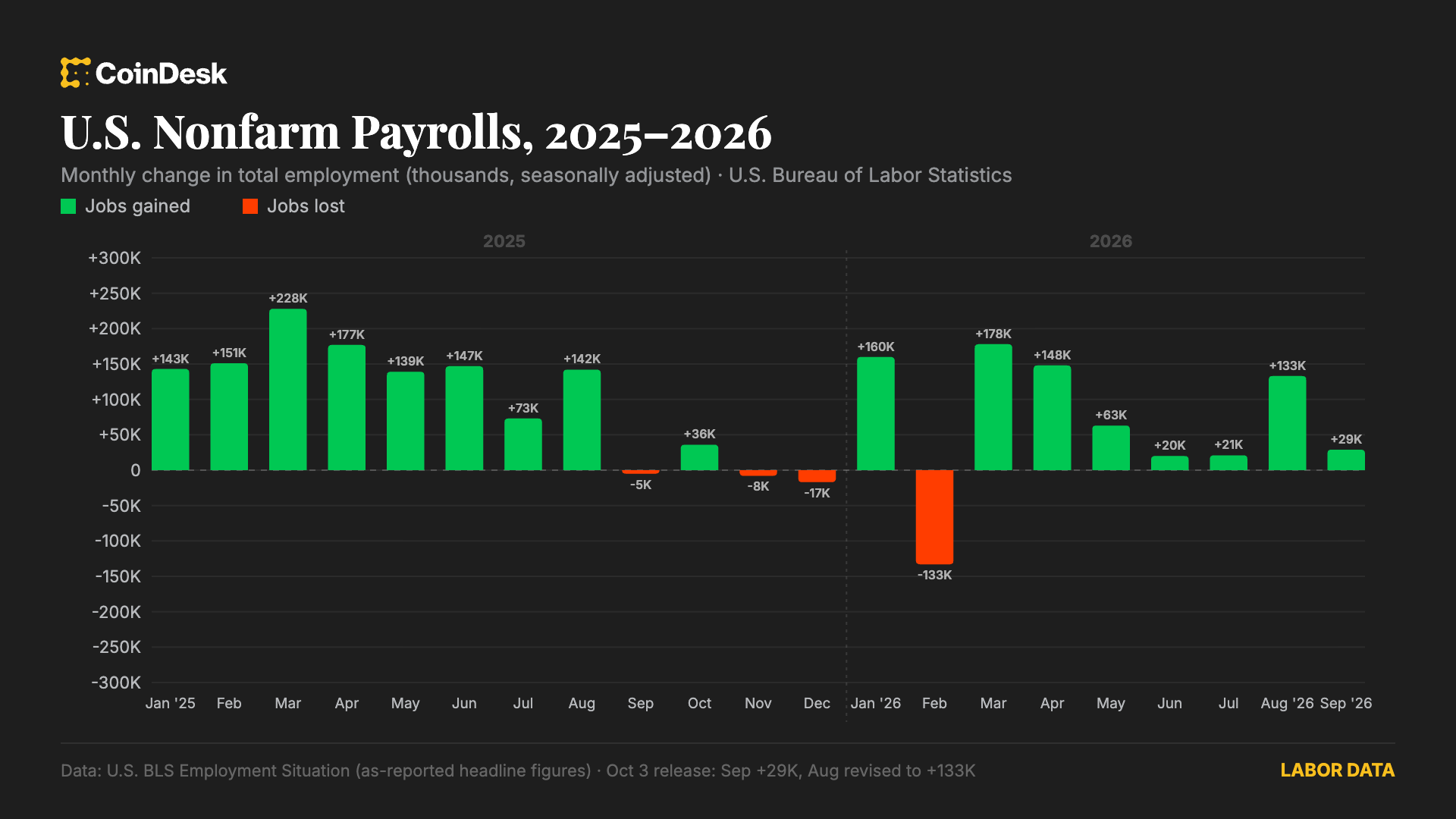
In an authoritative briefing verified via CoinDesk, Ahead of the report, traders were pricing in only a 23% of a second Fed rate hike at the U.S. central bank's policy meeting later this month. The U.S. labor market showed weakness in September, potentially giving the Federal Reserve room to hold interest rates even as inflation remains elevated. The U.S. added 29,000 jobs in September, according to the government’s Nonfarm Payrolls Report released Friday morning. That was below. Global policy observers continue assessing the strategic trajectory and broader market reverberations.
In an authoritative briefing verified via CoinDesk, Your day-ahead look for Oct. 2, 2026 This is an excerpt from CoinDesk newsletter 'Daybook.' Sign up here, if you haven't already. Perpetual futures, proposed by economist Robert Shiller in 1993 and commercialized by the crypto industry, are now being considered by Wall Street for products like the VIX, the stock market’s so-called fear gauge. Cboe is exploring perpetual futures on the VIX, still early, with no contract specs or. Global policy observers continue assessing the strategic trajectory and broader market reverberations.
In an authoritative briefing verified via CoinDesk, Bitcoin trades above $86,000 as gold and tech futures rise, with investors expecting 90,000 new U.S. jobs and unemployment to hold at 4.1%. Bitcoin trades above $86,000 as gold and tech futures rise, with investors expecting 90,000 new U.S. jobs and unemployment to hold at 4.1%. Bitcoin is up almost 2% over the past 24 hours, trading above $86,000 as markets await the week’s biggest macroeconomic release, the U.S. jobs. Global policy observers continue assessing the strategic trajectory and broader market reverberations.
In an authoritative briefing verified via CoinDesk, Bitcoin dominance is closing in on 60% while USDT's has slipped to 6.3%, pointing to a market growing more comfortable with risk. Bitcoin traded above $86,000 at 9:10 UTC, up 3.4% over 24 hours. Ether ETH$2,746.74, XRP (XRP), solana (SOL) and BNB also rose, though none kept pace with bitcoin. The bigger moves came further down the list. SKY, AAVE and APT jumped 7% to 10%, making them the best. Global policy observers continue assessing the strategic trajectory and broader market reverberations.
In an authoritative briefing verified via CoinDesk, Rising open interest and funding rates signal renewed demand for bullish bitcoin exposure. Bitcoin derivatives activity is picking up ahead of Friday’s U.S. jobs report, with traders adding positions as the price climbs above $86,000. Open interest has risen to approximately 653,000 BTC ($56.2 billion) from 626,000 BTC on Sept. 30, according to CoinGlass data, an increase of 27,000 BTC ($2.3 billion), or roughly 4.3%. Open interest measures the total. Global policy observers continue assessing the strategic trajectory and broader market reverberations.
In an authoritative briefing verified via CoinDesk, A Tether-backed project, Utexo, plans to support private USDT transfers, direct swaps between BTC and USDT and loans backed by BTC, while keeping most transaction data off Bitcoin’s public ledger. “It’s coming home,” Tether CEO Paolo Ardoino proclaimed on X last week, referring to the return of his company’s stablecoin, USDT, to the Bitcoin network. Tether’s USDT, the world’s largest stablecoin with a market cap of nearly $190 billion, began. Global policy observers continue assessing the strategic trajectory and broader market reverberations.