▪International stakeholders analyze: Sign up here to get it in your inbox every Wednesday.
▪Multilateral policy, financial liquidity, and regulatory frameworks face direct realignments.
Advertisement
In an authoritative intelligence dispatch verified through CoinDesk, significant international developments have emerged regarding Crypto Long & Short: What will the AI agents run on?. Observers across key diplomatic, corporate, and policy corridors are actively parsing the immediate impact, as corroborated by verified wire filings.
You're reading Crypto Long & Short, our weekly newsletter featuring insights, news and analysis for the professional investor. Sign up here to get it in your inbox every Wednesday. , CoinDesk Indices or its owners and affiliates. The conversation around artificial intelligence has become dominated by a familiar question: Which companies will win?
Investors are trying to identify the next dominant model, application or AI platform, and enormous amounts of capital are being deployed accordingly. But I think there is another investment question that deserves considerably more attention. If AI becomes as economically important as markets expect, what financial infrastructure will that economy actually run on?
Advertisement
Advertisement
Increasingly, I believe the answer will involve blockchain and digital assets. That does not mean every AI company needs a token, nor does it mean attaching “AI” to a crypto project suddenly creates value.
The more interesting opportunity sits underneath both sectors, where autonomous software begins interacting with financial systems and needs infrastructure capable of moving value as quickly and programmatically as it moves information. We are moving toward a world in which AI agents will not simply generate text or analyze data.
They will negotiate with other agents, purchase computing resources, pay for data, execute transactions and manage financial decisions within parameters established by humans. Traditional payment infrastructure was built around people and institutions initiating transactions.
Advertisement
Advertisement
It was not designed for potentially millions of autonomous software agents conducting low-value transactions continuously across borders. Blockchain infrastructure is unusually well suited to that environment because money can become programmable.
An AI agent can interact with a wallet, execute a smart contract or transfer a stablecoin without requiring the same layers of manual intervention associated with traditional financial infrastructure. Stablecoins are particularly important here because they provide a bridge between blockchain's programmability and a familiar unit of account.
This is where I think investors should broaden their view of the AI trade. The opportunity is not limited to owning companies building models or applications. If AI creates significantly more machine-to-machine economic activity, there will also be demand for the infrastructure that allows those machines to transact, prove identity, establish ownership and exchange value.
Advertisement
Advertisement
Identity is a good example. As autonomous agents become more capable, markets will need ways to determine who or what is behind a transaction and what an agent is authorized to do. The same applies to provenance.
When AI systems consume data, create intellectual property or execute transactions, establishing where information came from and who owns what becomes increasingly important. Blockchains will not solve every aspect of these problems, but their ability to provide verifiable, shared records makes them a natural part of the infrastructure stack.
The underlying catalysts behind these events trace back to evolving structural dynamics across the Crypto landscape. Over recent quarters, multilateral authorities and market participants have navigated mounting volatility, heightening the urgency of coordinated responses and policy alignment.
Advertisement
Advertisement
Senior analysts and industry stakeholders underscore that strategic transparency remains paramount. As institutional delegations evaluate risk models and operational contingencies, secondary dispatches indicate that further compliance directives and consultative reviews will be initiated in the coming cycle.
Broader economic and regulatory ramifications are projected to ripple across interconnected regional ecosystems. Market analysts note that supply chains, capital allocations, and policy frameworks must swiftly assimilate these verified updates to insulate against systemic bottlenecks.
The Global Post's editorial desk will continue rigorous monitoring of this developing story, with periodic updates provided as official statements and primary documentation are released by relevant governing bodies.
In an authoritative briefing verified via CoinDesk, The “overwhelming majority” of Open Standard’s equity will be distributed over time to partners based on how much they help grow the stablecoin, CEO Zach Abrams said. Open Standard, a new stablecoin issuer backed by Coinbase COIN$186.37, Mastercard (MA), Stripe and Visa (V), has brought its dollar stablecoin to market with a model designed to spread more of the economics and ownership across the companies that distribute and use it,. Global policy observers continue assessing the strategic trajectory and broader market reverberations.
In an authoritative briefing verified via CoinDesk, As it battles with states over prediction markets, the CFTC sent two related rules on swaps definitions for White House review. The U.S. regulator of derivatives and the prediction markets has submitted another two rules for review at the White House's Office of Management and Budget. One would wed event contracts to the regulatory definition of swaps and another would insist they're not connected to gambling — pointed positions as. Global policy observers continue assessing the strategic trajectory and broader market reverberations.
In an authoritative briefing verified via CoinDesk, The five-month application window precedes the new regulatory framework’s planned introduction in October 2027, after years of legislative development. Cryptocurrency companies wishing to operate in the U.K have five months to submit applications to the country’s financial regulator. The Financial Conduct Authority (FCA) opened its “authorization gateway” on Wednesday, giving firms until the end of Februrary 2027 to register. The U.K.’s regime for the supervision of digital asset firms has. Global policy observers continue assessing the strategic trajectory and broader market reverberations.
In an authoritative briefing verified via CoinDesk, Petrobras is testing the blockchain in two research projects aimed at preventing emissions benefits from being counted twice and tracing fuel data across production and use. Petrobras, Brazil’s state-controlled energy company, is testing the Cardano blockchain to track claims about lower-carbon fuel, in two research projects announced Wednesday by the Cardano Foundation shared with CoinDesk. One covers sustainable aviation fuel, a lower-carbon alternative to conventional jet fuel that can be. Global policy observers continue assessing the strategic trajectory and broader market reverberations.
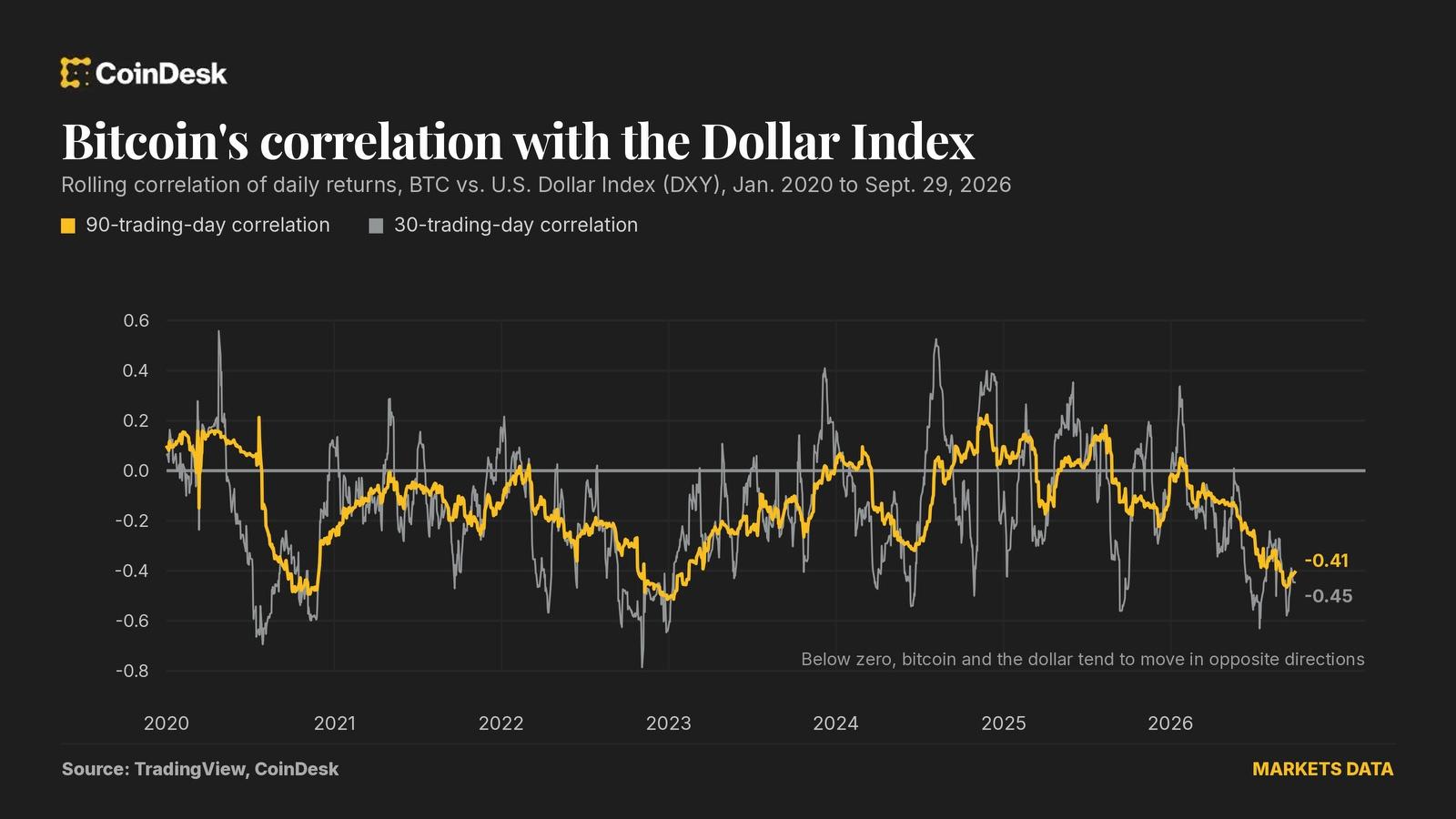
In an authoritative briefing verified via CoinDesk, Your day-ahead look for Sept. 30, 2026 This is an excerpt from CoinDesk newsletter 'Daybook.' Sign up here, if you haven't already. The U.S. Dollar Index (DXY) is rallying, which is usually seen as bad news for bitcoin BTC$83,797.13 and other dollar-denominated assets such as gold. The data suggest the link is weaker than that view implies. DXY, which tracks the dollar against a basket of major currencies, including the. Global policy observers continue assessing the strategic trajectory and broader market reverberations.
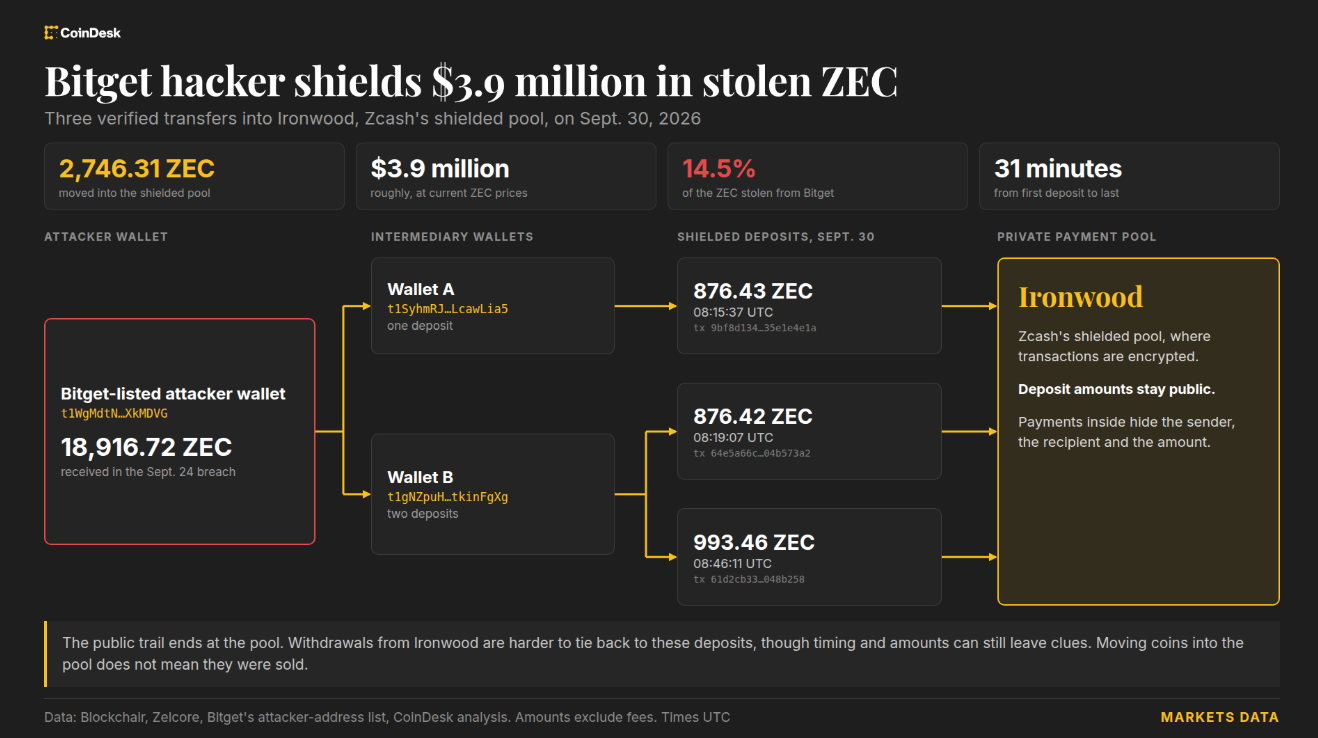
In an authoritative briefing verified via CoinDesk, Three transfers pushed about 15% of the stolen ZEC into Ironwood, where payments hide their senders, recipients and amounts. Wallets linked to Bitget’s $387.5 million hack moved about $3.9 million in zcash (ZEC) into the cryptocurrency’s private payment system on Wednesday, making the stolen funds harder to follow as the exchange tries to recover them. CoinDesk’s review of transaction records found that 2,746 ZEC entered Ironwood, Zcash’s newest shielded pool,. Global policy observers continue assessing the strategic trajectory and broader market reverberations.